

 英语
英语 中文简体
中文简体



For many EV charging projects, selecting an accurate AC or DC energy meter has traditionally been treated as the main metering decision.
Directive (EU) 2026/706 makes the boundary of the complete EVSE measuring system more important.
Adopted on 11 March 2026, the Directive amends Directive 2014/32/EU and introduces MI-011, an instrument-specific category covering measuring systems for electric vehicle supply equipment. MI-011 applies to the relevant metrological functions associated with conductive active-energy transfer between EVSE and an electric vehicle at a specified transfer point.
For EVSE manufacturers, the central question is therefore no longer only:
Has the selected energy meter successfully completed its applicable conformity-assessment procedure?
It is also:
Does the complete EVSE measuring system correctly measure, process, protect and present the legally relevant result at the specified transfer point?
The metrological functions within an EVSE measuring system may be provided by an active electrical energy meter for which a conformity-assessment procedure has been successfully completed in accordance with Annex V to Directive 2014/32/EU. The results of that meter assessment may be considered during the MI-011 system assessment, but they do not automatically establish conformity of the complete EVSE measuring system.
Regulatory note: This article provides a technical overview for early project evaluation. It is not legal advice or a conformity-assessment decision. The applicable route must be confirmed with the responsible notified body, conformity-assessment parties and authorities for the target market.
Key Takeaways
- MI-011 regulates the complete EVSE measuring system, not only the energy meter.
- The specified transfer point determines whether AC active energy or DC energy is measured.
- A successfully assessed active electrical energy meter does not automatically establish complete-system conformity.
- Cables, connectors, sensing components, software, displays and records may form part of the assessed configuration where they perform or affect relevant metrological functions.
- Manufacturers should begin architecture, documentation and conformity-route reviews before the 2028 application date.
For a broader overview of charger architectures and metering applications, see YTL’s EV charging metering applications page.
What Has Changed under Directive (EU) 2026/706?
Directive 2014/32/EU already covered active electrical energy meters under MI-003.
Directive (EU) 2026/706 adds EVSE measuring systems under MI-011. The assessment object is therefore broader than a standalone AC or DC meter.
Depending on the architecture, the metrologically relevant configuration may include:
- AC or DC measurement functions
- Voltage- and current-sensing components
- Charger-controller functions that process or associate legally relevant measurement results
- Software that forms, protects, stores, presents or verifies the regulated result
- Measurement results used for a transaction
- Energy-transfer direction
- Presentation or readout functions
- Protected records
- Measuring-system identification
- Configuration control
- Protection against unauthorized modification
A charger controller or software component is not automatically metrologically relevant merely because it is installed in the charger. Its status depends on whether it participates in forming, processing, associating, protecting, presenting or verifying the regulated measurement result.
EVSE manufacturers should therefore document the complete measurement architecture rather than evaluating only the meter component.
What Is an MI-011 EVSE Measuring System?
An MI-011 EVSE measuring system contains the relevant metrological functions associated with the conductive transfer, in either direction, of active electrical energy between EVSE and an electric vehicle at a specified transfer point.
|
Component |
Main role |
Automatically establishes MI-011 conformity? |
|
Energy meter |
Measures AC or DC electrical energy |
No |
|
Sensing components |
Provide voltage or current inputs |
No |
|
Charger controller |
May process or associate measurement results |
No |
|
Presentation or readout function |
Makes the relevant result available |
No |
|
EVSE measuring system |
Combines the applicable metrological functions |
This is the MI-011 assessment object |
|
CSMS or OCPP platform |
Supports communication and downstream processing |
No |
A successfully assessed active electrical energy meter can be used as a component. Its conformity-assessment result does not automatically cover the controller, relevant software, result presentation, protected records, cable configuration or complete system architecture.
Energy Meter versus Complete EVSE Measuring System
The energy meter performs measurement within its specified:
- Accuracy framework
- Electrical range
- Rated operating conditions
- Firmware configuration
- Hardware configuration
- Conformity-assessment scope
The complete EVSE measuring system may additionally need to ensure that:
- The measurement corresponds to the specified transfer point
- The correct result is assigned to the correct measurement event or transaction
- Energy direction is interpreted consistently
- Legally relevant results are protected
- The result is made available to the parties concerned
- Presented and stored results remain traceable
- Metrologically relevant software and configuration changes are controlled
- Replacement components remain identifiable
- The assessed system configuration remains reproducible
The practical procurement conclusion is:
A successfully assessed active electrical energy meter can be an important component, but it does not by itself establish MI-011 conformity of the complete EVSE measuring system.
MI-011 Does Not Cover Every Requirement for the Complete Charger
MI-011 concerns the EVSE measuring system and its metrologically relevant configuration.
It does not automatically establish compliance with every other legal or technical requirement that may apply to the complete charging equipment.
Other requirements may concern:
- Electrical safety
- Electromagnetic compatibility
- Radio equipment
- Cybersecurity
- Payment systems
- Consumer information
- Accessibility
- Grid connection
- Installation
- In-service verification
- Market-specific operation
These subjects may be governed by other EU legislation, standards or national rules.
MI-011 covers the EVSE measuring system, not every legal requirement applicable to the complete charging equipment.
Transitional Dates Manufacturers Should Distinguish
The transition arrangements should not be reduced to a general statement that “existing certificates remain valid.”
Different provisions apply according to the instrument, certificate, applicable earlier law and date on which the product is placed on the market.
|
Date |
What manufacturers should review |
|
10 April 2028 |
Deadline for Member States to adopt and publish the necessary national transposition measures |
|
10 October 2028 |
Date from which Member States must apply the national transposition measures |
|
10 April 2030 |
Transitional date concerning measuring instruments in the newly added Annexes Va and VIIa that comply with prior national law and satisfy the conditions in Article 2(2) |
|
10 April 2038 |
Latest validity date for certain relevant certificates issued before 10 October 2028, unless they expire earlier |
Article 2(1) also protects eligible instruments conforming to Directive 2014/32/EU as applicable before the amendment, provided that they were placed on the market before 10 October 2028. This provision should not be interpreted as automatically covering every existing EVSE, meter or certificate.
The exact treatment must be assessed according to:
- Product category
- Certificate scope
- Member State
- Prior national rules
- Placing-on-the-market date
- Applicable assessed configuration
Placing on the Market versus Putting into Use
Manufacturers should distinguish several EU market concepts:
- Placing on the market:generally, the first time a product is made available on the EU market.
- Making available on the market:a subsequent supply or distribution activity in the market.
- Putting into use:the first use of the instrument for its intended purpose.
The applicable transition should not be assessed only from the manufacturing date, order date, project contract date or installation date.
The actual placing-on-the-market and putting-into-use circumstances should be reviewed by qualified regulatory personnel for the relevant product and Member State.
Where Is the Specified Transfer Point?
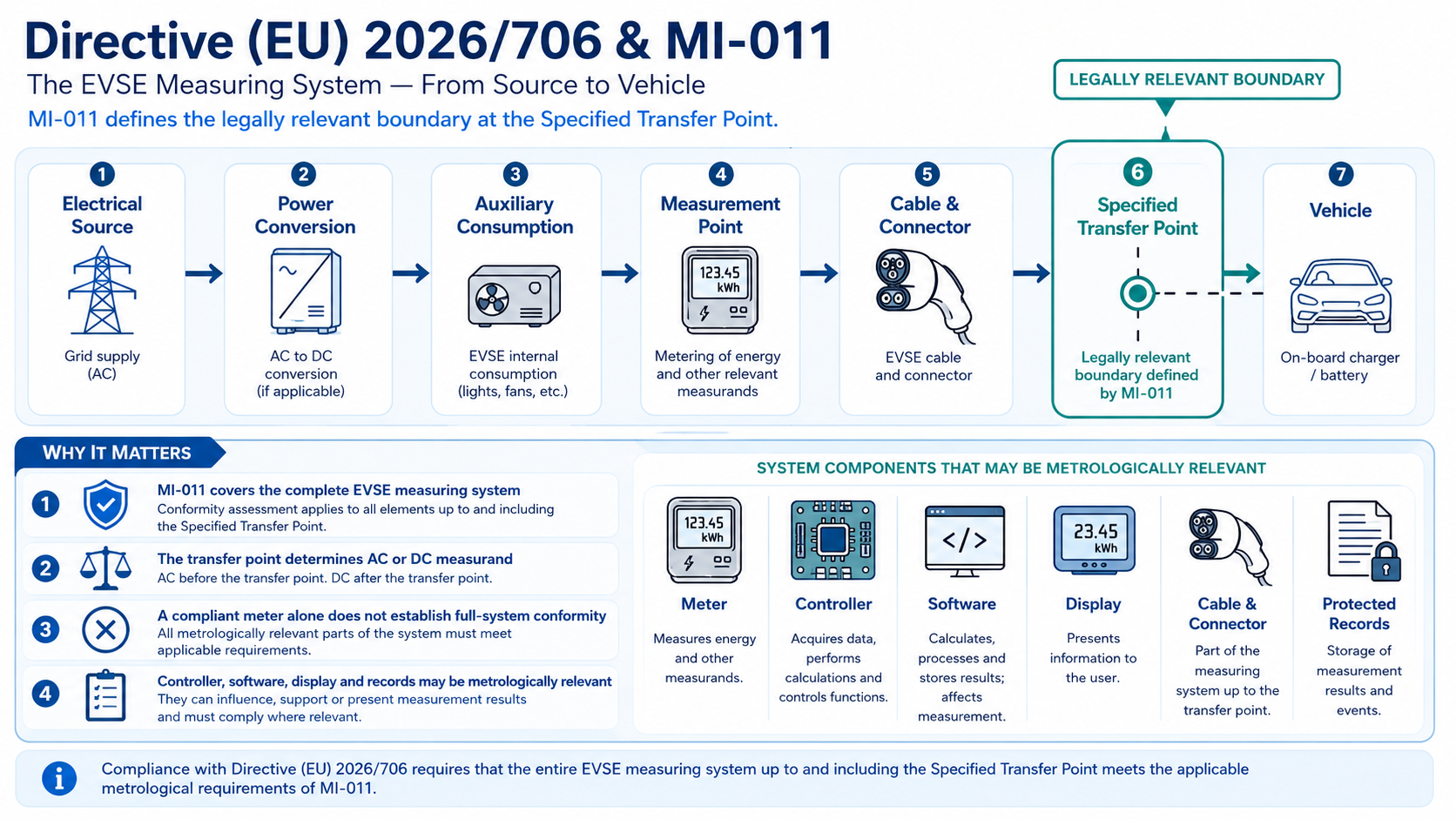
The transfer point determines the legally relevant measurement boundary.
It affects:
- Whether AC or DC energy is the measurand
- Which conversion losses fall inside or outside the boundary
- Whether auxiliary consumption is included
- Which meter and sensing architecture is appropriate
- Which result forms the regulated transaction measurement
- How bidirectional energy is represented
MI-011 determines measuring-system accuracy at the specified transfer point. Where DC energy is exchanged at that point, DC energy is the measurand. Where AC energy is exchanged, AC active energy is the measurand.
A simplified architecture may look like:
Electrical Source
→ Power Conversion
→ Auxiliary Consumption
→ Measurement Point
→ Cable and Connector
→ Specified Transfer Point
→ Vehicle
An AC-input meter and a vehicle-side DC measuring arrangement may produce different results because conversion losses and auxiliary consumption can exist between those locations.
The transfer point should therefore be defined before meter selection, cable design, charger architecture and conformity-assessment planning are finalized.
For a practical explanation of input-side, output-side, AC and DC measurement boundaries, see YTL’s guide to AC vs DC metering in EV charging projects.
How the Rules Apply to AC, DC and Bidirectional Charging
AC charging
Where AC energy is transferred at the specified transfer point, AC active energy is the relevant measurand.
Manufacturers should confirm:
- Measurement location
- Direct or CT-operated measurement
- Current and voltage range
- Phase configuration
- Energy direction
- Losses between the measurement point and transfer point
- Intended MI-011 class
- Rated operating conditions
DC charging
DC charging equipment normally contains an AC/DC conversion stage.
An AC-input meter may include conversion and auxiliary losses that are not equivalent to the DC energy transferred at a vehicle-side DC transfer point.
Where the transfer point is DC, manufacturers should review:
- DC voltage range
- Current-sensing method
- Shunt or other sensing architecture
- Polarity
- Energy direction
- Cable and connector effects
- Temperature effects
- Complete-system accuracy at the transfer point
Bidirectional charging
The MI-011 definition covers conductive energy transfer in either direction.
Bidirectional architectures should define:
- Import and export reference directions
- Charging and discharging registers
- Positive and negative sign conventions
- Direction changes during a session
- Presentation of each direction
- Transaction-record treatment
- Billing or settlement workflow
- Consistency between meter, controller and relevant software
A positive value must have the same defined meaning throughout the assessed measurement path.
Accuracy Classes, MPE Framework, Operating Range and MMQ
MI-011 defines the following class indices:
- Class A: 2%
- Class B: 1%
- Class C: 0.5%
These values are class indices used within the MI-011 accuracy framework. They are not standalone guarantees that every measurement under every condition will remain within ±2%, ±1% or ±0.5%.
Applicable maximum permissible errors and permitted error shifts depend on matters such as:
- Current range
- Rated operating conditions
- Voltage
- Frequency
- Temperature
- Influence quantities
- Complete-system performance at the transfer point
Manufacturers should confirm:
- Starting current
- Minimum current
- Transitional current
- Maximum current
- Rated voltage
- AC frequency range
- Temperature range
- DC output-voltage range, where applicable
- Applicable influence quantities
- Required class and MPE performance across the intended operating range
The selected class should not be treated only as a label on the meter component. Applicable performance must be demonstrated for the EVSE measuring system at the specified transfer point.
Minimum Measured Quantity
MI-011 also sets maximum values for the minimum measured quantity, or MMQ:
- AC EVSE measuring systems: no more than 0.1 kWh
- DC EVSE measuring systems: no more than 1 kWh
MMQ relates to the smallest transaction quantity declared by the manufacturer for which the measuring system satisfies the applicable MPE requirements.
It should not be simplified into:
- A minimum permitted charging session
- A universal minimum billing quantity
- A requirement that every DC charging transaction must exceed 1 kWh
- A rule prohibiting billing below 0.1 kWh
Manufacturers should assess how resolution, result presentation and transaction processing behave near the declared MMQ.
Cable and Connector Requirements
A cable and connector may form part of the metrologically relevant path where they are located between the measurement point and the specified transfer point.
MI-011 distinguishes between non-replaceable and replaceable configurations.
Non-replaceable cable and connector
Where the cable and connector are not replaceable, they must be secured by an appropriate hardware seal.
Replaceable cable and connector
Where replacement is intended while the EVSE measuring system remains under seal, the cable and connector must:
- Be identified in the relevant conformity assessment as interchangeable
- Match the compatible characteristics marked on the measuring system
- Carry their applicable characteristics and unique identification
- Be separately sealed
- Be replaceable without accessing or breaking the sealed metrological parts of the measuring system
These requirements mean that the cable cannot always be treated as a purely mechanical accessory.
Its characteristics, identity, losses and replacement procedure may affect the assessed configuration.
Manufacturers should document:
- Cable length
- Conductor characteristics
- Connector type
- Identification method
- Seal arrangement
- Replacement procedure
- Approved interchangeable configurations
- How cable and connector effects are addressed in the transfer-point accuracy assessment
The Directive does not prescribe one universal cable-loss compensation algorithm.
In practice, manufacturers should demonstrate through the assessed design how cable and connector effects are addressed so that the complete measuring system satisfies the applicable accuracy requirements at the specified transfer point.
The accepted implementation should be confirmed with the responsible notified body or conformity-assessment party.
Which EVSE Data Is Legally Relevant?
Not every value produced by the charger or transmitted to a backend is automatically metrologically relevant.
The Directive does not prescribe one identical legally relevant data schema for every EVSE architecture.
A field may become metrologically relevant where it participates in forming, associating, protecting, presenting or verifying the regulated measurement result.
Data that may be metrologically relevant
Depending on the assessed design and transaction workflow, this may include:
- Transaction measurement result
- Start and stop readings
- Billable energy
- Energy-transfer direction
- Measuring-system identity
- Meter identity
- Legally relevant presented result
- Protected measurement record
- Timestamp, where included in the assessed design
- Transaction association, where included in the assessed design
Operational data
Operational data may include:
- Instantaneous voltage
- Current
- Power
- Temperature
- Charger status
- Load-management values
- Diagnostics
- Communication status
- Internal power-module data
A timestamp, transaction identifier or backend field is not automatically legally relevant merely because it appears in a charger database or OCPP message.
Its status depends on the assessed measuring-system architecture, intended transaction workflow and role in the protected result.
Similarly, an OCPP MeterValues field is not automatically a legally controlled billing result.
Presentation, Transaction Records and Data Traceability
The legally relevant result must be made available through a presentation or readout arrangement permitted by the applicable requirements and assessed design.
Depending on the architecture, this may involve:
- A metrologically controlled local indication
- A readout system
- A printout
- A permitted remote indication
- Presentation on the user’s device
This does not necessarily mean that every EVSE measuring system must have a permanent physical LCD.
The result on which the transaction is based must remain available until the parties concerned have accepted it at the conclusion of the measurement.
EVSE manufacturers should review:
- How the result is made available
- Units and decimal presentation
- Start and stop results, where relevant
- Measuring-system identification
- Customer access
- Protected record retention
- Consistency between presented and stored results
- Behavior after communication failure
- Behavior after power loss
- Behavior after restart
- Component-replacement traceability
Where presented, stored and backend results follow different processing paths, the assessed design must demonstrate how those results remain consistent and traceable.
Tamper Protection, Software and Configuration Control
Metrological protection may involve more than a physical seal.
Relevant controls can include:
- Hardware seals
- Access-control levels
- Protected parameters
- Software identification
- Firmware-version control
- Audit records
- Tamper-event records
- Cryptographic protection
- Controlled software updates
- Controlled component replacement
- Reset restrictions
- Configuration traceability
Not every software function in an EV charger is automatically legally relevant.
Manufacturers should identify the software functions that:
- Calculate the regulated result
- Associate the result with a measurement event or transaction
- Apply direction or scaling
- Protect the result
- Store the result
- Present the result
- Support verification of the result
A firmware, controller or configuration change affecting one of these functions may affect the assessed design.
A routine software update should not automatically be assumed to remain within the approved configuration. Its impact should be reviewed through the documented change-control and conformity-assessment process.
Meter Conformity Assessment versus MI-011 System Conformity
EVSE manufacturers should separate two questions:
- Has the active electrical energy meter successfully completed the applicable conformity-assessment procedure for its own metrological functions?
- Has the complete EVSE measuring system been assessed against the applicable MI-011 requirements?
MI-011 identifies these conformity-assessment procedures:
- B + F
- B + D
- H1
- G
These should not be treated as four routes that a manufacturer may select solely according to price or preference.
The applicable procedure should be selected in accordance with:
- The MI-011 provisions
- Product and system design
- Manufacturer’s production arrangement
- Quality-assurance system
- Batch or individual-unit production model
- Technical documentation
- Assessment approach accepted by the relevant notified body or responsible conformity-assessment party
Manufacturers should confirm:
- Who acts as the manufacturer of the EVSE measuring system under Directive 2014/32/EU
- Which components form the assessed configuration
- Which software functions are metrologically relevant
- Which meter conformity-assessment result and scope apply
- Which hardware and firmware versions are covered
- Which cable and connector configurations are covered
- Which prior test results may be considered
- Which system-level tests remain necessary
- Which operating and environmental conditions apply
- Which conformity-assessment procedure applies
- Whether and where a notified body is involved
- Which national rules apply outside the harmonized product requirements
National provisions may concern:
- Transposition
- Installation
- Use
- In-service verification
- Billing
- Market surveillance
- Enforcement
This does not mean that Member States may arbitrarily redefine the harmonized MI-011 product requirements.
How Directive (EU) 2026/706 Relates to OCPP and Signed Meter Values
OCPP addresses communication between a Charging Station and a Charging Station Management System.
MI-011 addresses the regulated EVSE measuring system and its legally relevant measurement result.
EVSE Measuring System
→ Legally Relevant Measurement Result
→ Charging-Station Software
→ OCPP Communication
→ CSMS / Billing Workflow
Signed meter values may support the integrity, transmission and later verification of protected measurement information.
However, the Open Charge Alliance white paper is limited to the standardized transport of signed meter values between the Charging Station and the CSMS. It does not establish complete legal-metrology compliance for the full EVSE measurement and billing chain.
Therefore:
Signed meter values can support traceability, but they do not replace MI-011 conformity assessment of the complete EVSE measuring system or other applicable legal-metrology requirements.
What EVSE Manufacturers Should Review Now
|
Review area |
What to confirm |
|
Target market |
EU country, intended application and implementation timeline |
|
Market status |
Placing on the market, making available and putting into use |
|
Transitional status |
Applicable 2028, 2030 and 2038 provisions |
|
Charging type |
AC, DC or bidirectional |
|
Transfer point |
Legally relevant energy boundary |
|
Measuring architecture |
Standalone meter or embedded measurement function |
|
Measurand |
AC active energy or DC energy |
|
Accuracy framework |
Class A, B or C and applicable MPE requirements |
|
Operating range |
Starting, minimum, transitional and maximum current |
|
Rated conditions |
Voltage, frequency, temperature and applicable influence quantities |
|
MMQ |
Declared AC or DC minimum measured quantity |
|
Cable and connector |
Identification, sealing, replacement and accuracy effects |
|
Direction |
Import/export and charge/discharge convention |
|
Relevant data |
Data participating in the regulated measurement result |
|
Presentation |
Local, remote, printout, readout or user-device arrangement |
|
Data integrity |
Storage, protection, signature and verification |
|
Software |
Metrologically relevant functions and version control |
|
Meter assessment |
Model, scope, hardware and firmware configuration |
|
MI-011 assessment |
Applicable B+F, B+D, H1 or G procedure |
|
Change control |
Meter, cable, controller, software and configuration changes |
|
National provisions |
Rules outside harmonized product requirements |
|
Pilot testing |
Meter, complete measuring system, presentation and transaction tests |
How YTL Can Support Early Metering Evaluation
Zhejiang Yongtailong Electronic Co., Ltd. (YTL) manufactures AC and DC energy-metering products for EV charging, commercial and industrial energy management, PV/ESS and power-distribution applications.
YTL can support the initial evaluation of metering hardware based on:
- Specified transfer point
- AC or DC architecture
- Measurement range
- Direct, CT-based or shunt-based measurement
- Required energy and electrical values
- Import/export requirements
- Communication interface
- Data-output needs
- Installation conditions
- Target market
Support may include:
- Initial model evaluation
- Electrical-range review
- Communication and data-output confirmation
- Register-map review
- Sample testing
- Project-specific technical discussion
The role of a selected YTL meter within an MI-011 EVSE measuring-system project must be confirmed against the meter’s conformity-assessment status, certificate scope, hardware, firmware, electrical architecture and complete-system assessment route.
A meter supplier can provide component information and technical support. The manufacturer of the EVSE measuring system and the responsible conformity-assessment parties must determine the final regulatory route.
FAQ
What is an MI-011 EVSE measuring system?
It is the system containing the relevant metrological functions associated with conductive active-energy transfer between EVSE and a vehicle at a specified transfer point.
Does a successfully assessed energy meter make an EV charger MI-011 compliant?
No. The meter may provide metrological functions within the system, but the MI-011 assessment object is the complete EVSE measuring system and its relevant configuration.
Is MI-011 conformity the same as conformity of the entire charger?
No. MI-011 concerns the measuring system. Electrical safety, EMC, cybersecurity, radio, payment, accessibility and other requirements may be covered separately.
What are the MI-011 accuracy classes?
MI-011 uses Class A, B and C indices of 2%, 1% and 0.5%. These indices are part of a wider MPE framework and should not be interpreted as universal fixed accuracy guarantees under every operating condition.
What is MMQ?
MMQ is the minimum measured quantity for which the manufacturer declares that the measuring system satisfies the applicable MPE requirements.
Is MMQ the minimum amount a customer must purchase?
No. The MMQ values should not be interpreted as universal minimum session-energy or billing thresholds.
Why do the cable and connector matter?
Where they lie between the measurement point and transfer point, their characteristics, losses, identity, sealing and replacement may affect the assessed configuration and transfer-point accuracy.
Does MI-011 apply to bidirectional charging?
The definition includes energy transfer in either direction. The assessed architecture should therefore define direction, registers, presentation and transaction treatment.
Are all OCPP MeterValues legally relevant?
No. Their status depends on their function within the assessed measuring-system design and transaction workflow.
Do signed meter values establish MI-011 conformity?
No. They may support protected transport and later verification, but they do not replace conformity assessment of the EVSE measuring system.
Can a manufacturer freely choose B+F, B+D, H1 or G?
Not solely according to preference. The applicable procedure depends on MI-011, the design, manufacturing and quality arrangements, and the approach accepted by the responsible notified body or conformity-assessment party.
What should an EVSE manufacturer provide to a meter supplier?
The manufacturer should provide the specified transfer point, AC or DC architecture, electrical range, measurement method, communication needs, installation conditions and target market.
Conclusion
Directive (EU) 2026/706 changes EV charging metering from a component-only question into a complete measuring-system question.
EVSE manufacturers should remember five principles:
- A successfully assessed active electrical energy meter does not automatically establish MI-011 conformity of the EVSE measuring system.
- The specified transfer point determines whether AC active energy or DC energy is the measurand.
- MI-011 includes an accuracy and MPE framework, rated operating conditions and MMQ requirements.
- Cables, connectors, sensing components, relevant software, presentation functions and records may form part of the assessed configuration.
- The applicable conformity-assessment procedure must be established for the complete EVSE measuring system.
Manufacturers that review these boundaries early can reduce the risk of selecting a meter, cable, controller or software architecture that later conflicts with the intended assessment route.
Planning an AC or DC EVSE metering project? Contact YTL and share the specified transfer point, electrical architecture, measurement range, communication needs and target market for initial model evaluation.
Official References
- European Union — Directive (EU) 2026/706 amending Directive 2014/32/EU as regards measuring systems for electric vehicle supply equipment and other measuring instruments.
- European Union — Directive 2014/32/EU on measuring instruments.
- Open Charge Alliance — Signed Meter Values in OCPP.